Image from fruitrootleaf
The Quebec Chronicle-Telegraph, an English language paper published in the venerable city of francophones claims on its banner to be the continent's oldest, and arguably, it is. The Halifax Gazette (1752) was really just a gazette.
Established in 1764, The Quebec Chronicle-Telegraph is over 250 years old, and describes itself as the "descendant of several newspapers published in the 18th, 19th and 20th centuries." During the crisis that followed the 1765 Stamp Act, and again in 1775-6 when the Revolutionary war began and the city was besieged by American troops, there were interruptions to service. Besides these historic disruptions, the newspaper has operated continuously since.
In its early days, the paper was a weekly, with separate editions in English and French. Later, it became a daily, and French and English editions came out on alternate days. In 1874, the Quebec Gazette was joined to the Morning Chronicle.
When the Daily Telegraph appeared in 1875, it offered a more liberal perspective to the city's newspaper readers. However, as the English-speaking population of Quebec City declined in the late 19th and early 20th centuries, the two papers joined forces due to economic pressures. The paper returned to its original weekly format in 1971.
Monday, December 7, 2015
Sunday, December 6, 2015
Bald eagle moves house as White Rock fells beachside trees
As I walked along the beach, I saw some people craning their heads upward. They were gazing at this eagle on West Beach, watching out to sea. Someone said the eagles had been forced to find new trees when they were driven from their old haunts on East Beach.
With permission from the City of White Rock, BNSF Rail has finished cutting down the lovely stand of mature trees that used to flank the railroad on East Beach. This is what it looks like now.
Saturday, December 5, 2015
Early New Brunswick newspapers
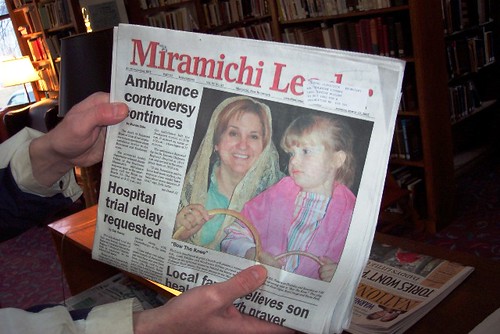
Image of Miramichi Leader from flickr
When Canada was still a group of colonies, the main purpose of the early newspapers, called gazettes, was to inform colonists about government appointments and new legislation. These also carried some marriage and death notices, but only those of "important" people.
The Saint John Gazette was published between 1784 and 1807 and the New Brunswick Courier from 1811-1865. Between 1829 and 1880, the Gleaner served Miramichi and Northumberland County. Many other newspapers came and went during the late nineteenth and early twentieth century. The Royal Gazette, first seen in 1785, continues to be published in Fredericton by the Queen's Printer.
The Daily Gleaner, a Fredericton paper, dates back to 1889. I have been unable to learn when the first issue of the Miracmichi Leader was published. Perhaps it goes back to the days of the Loyalists.
When Canada was still a group of colonies, the main purpose of the early newspapers, called gazettes, was to inform colonists about government appointments and new legislation. These also carried some marriage and death notices, but only those of "important" people.
The Saint John Gazette was published between 1784 and 1807 and the New Brunswick Courier from 1811-1865. Between 1829 and 1880, the Gleaner served Miramichi and Northumberland County. Many other newspapers came and went during the late nineteenth and early twentieth century. The Royal Gazette, first seen in 1785, continues to be published in Fredericton by the Queen's Printer.
The Daily Gleaner, a Fredericton paper, dates back to 1889. I have been unable to learn when the first issue of the Miracmichi Leader was published. Perhaps it goes back to the days of the Loyalists.
Friday, December 4, 2015
The Guardian, Charlottetown PEI
Image of a 1922 edition from pei archives
The Guardian began publishing as a daily in 1887 as the Morning Guardian. Over the years, this paper has also been known as the Guardian of the Gulf and the Charlottetown Guardian.
I'm sure this paper was read by Lucy Maud Montgomery, and probably by her fictional creations, Matthew, Marilla and Anne of Green Gables as well. In 2014 Mark Leggott, a Librarian at the University of PEI, put the Guardian archive online, making it possible to search back through issues from 1890 to 1957.
The Guardian began publishing as a daily in 1887 as the Morning Guardian. Over the years, this paper has also been known as the Guardian of the Gulf and the Charlottetown Guardian.
I'm sure this paper was read by Lucy Maud Montgomery, and probably by her fictional creations, Matthew, Marilla and Anne of Green Gables as well. In 2014 Mark Leggott, a Librarian at the University of PEI, put the Guardian archive online, making it possible to search back through issues from 1890 to 1957.
Thursday, December 3, 2015
Acadie-Nouvelle, Caraquet NB
Image from cbc
The French language Acadie-Nouvelle, in Caraquet NB, is a recently established paper *available online since 2003).
It caters to francophone Maritimers, and its name (meaning the Acadia News in English) refers back to the Acadians. These French pioneers settled in the Maritimes, arriving as early as 1604. They were deported from Nova Scotia in 1713, after France ceded Nova Scotia to England in the Treaty of Utrecht. Still a strong ethnic group, they enjoy this French language paper.
The French language Acadie-Nouvelle, in Caraquet NB, is a recently established paper *available online since 2003).
It caters to francophone Maritimers, and its name (meaning the Acadia News in English) refers back to the Acadians. These French pioneers settled in the Maritimes, arriving as early as 1604. They were deported from Nova Scotia in 1713, after France ceded Nova Scotia to England in the Treaty of Utrecht. Still a strong ethnic group, they enjoy this French language paper.
Wednesday, December 2, 2015
The Chronicle Herald, Halifax
Image of new of the Halifax disaster of 1917 from oceanliners
Among Canada's oldest independently owned papers, this daily (except Sunday) began as the Halifax Herald.
The accompanying image shows the report of Halifax Disaster that happened during World War I when a munitions ship collided with another in the harbour. This newspaper described the explosion (the worst human-caused one to date) and its horrible aftermath.
In 2013, the Chronicle Herald, then 189 years old, stopped publishing the Sunday edition it had instituted fifteen years before. The publisher stated that the day of print journalism is not over, but it continues to adapt.
Among Canada's oldest independently owned papers, this daily (except Sunday) began as the Halifax Herald.
The accompanying image shows the report of Halifax Disaster that happened during World War I when a munitions ship collided with another in the harbour. This newspaper described the explosion (the worst human-caused one to date) and its horrible aftermath.
In 2013, the Chronicle Herald, then 189 years old, stopped publishing the Sunday edition it had instituted fifteen years before. The publisher stated that the day of print journalism is not over, but it continues to adapt.
Tuesday, December 1, 2015
The Telegram, St. John's NL
Image of first issue from Heritage Newfoundland
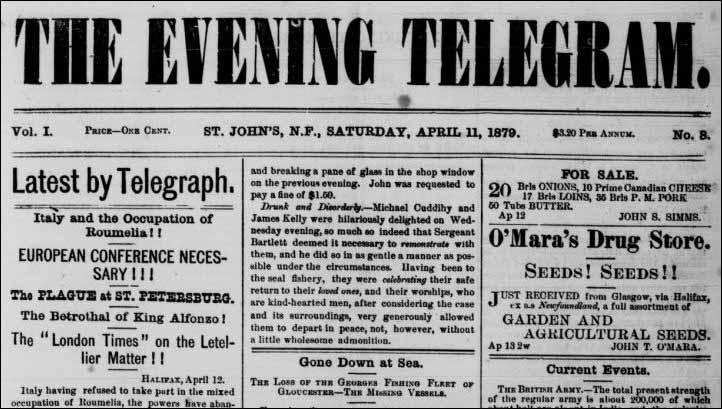
Now called simply The Telegram, this newspaper soldiers on, including of course, an online version. Notice the biggest headline: "Latest by Telegraph." At the time, the undersea cable had recently been laid across the Atlantic from Ireland to Heart's Content, Newfoundland, now a historic site.
This evening paper got its start in April 1879. It would be another 70 years, however, before the final province joined the Canadian federation, so this was not a Canadian paper -- yet. From 1879 to 1958, it was published daily except Sundays.
As a Newfoundlander, my mother had to emigrate when she married: she left in 1946, three years before Newfoundland joined Confederation. She had fond memories of the Evening Telegram, and I remember, even as a child, being surprised that this paper came out in the evening from its early beginnings. In their heyday, of course. many newspapers had both early and late editions.
There were Newfoundland papers more venerable than the Telegram. The Public Ledger, the Patriot, the Times and the Newfoundlander, However, though they started as early as the 1820s, did not last out the nineteenth century.
Now called simply The Telegram, this newspaper soldiers on, including of course, an online version. Notice the biggest headline: "Latest by Telegraph." At the time, the undersea cable had recently been laid across the Atlantic from Ireland to Heart's Content, Newfoundland, now a historic site.
This evening paper got its start in April 1879. It would be another 70 years, however, before the final province joined the Canadian federation, so this was not a Canadian paper -- yet. From 1879 to 1958, it was published daily except Sundays.
As a Newfoundlander, my mother had to emigrate when she married: she left in 1946, three years before Newfoundland joined Confederation. She had fond memories of the Evening Telegram, and I remember, even as a child, being surprised that this paper came out in the evening from its early beginnings. In their heyday, of course. many newspapers had both early and late editions.
There were Newfoundland papers more venerable than the Telegram. The Public Ledger, the Patriot, the Times and the Newfoundlander, However, though they started as early as the 1820s, did not last out the nineteenth century.
Subscribe to:
Posts (Atom)