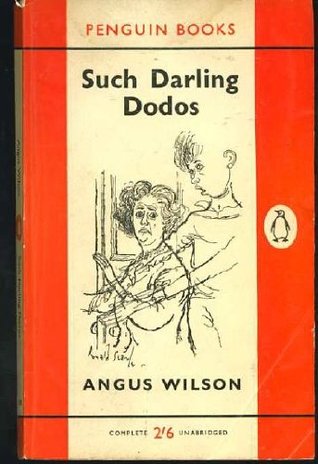
Image from Goodreads
The collection of short stories by Angus Wilson, Such Darling Dodos (London: Secker and Warburg, 1954), is satirical, funny and brilliant. I borrowed this copy, a third imprint after its original publication in 1950, from the Vancouver Public Library. Some of Wilson's novels have been reissued since 2000.
Wilson's habit of omniscient narration allows him to plumb his characters thoroughly. In "Learning's Little Tribute," we are shown Miss Wells, "scuttling with unseemly haste" toward the cemetery gates after the funeral of a colleague. This, even though she is well aware that while it is right "to leave the relatives to their private grief," one should not depart "at the double."
This lady's misfortune, Wilson tells us, is that "though well equipped with the proper rules of conduct in life, she too often spoiled their effect in her anxiety to show her knowledge of them."
Later in the story, the snobbery of Mr. Brunton, with his "sharp little eyes" and "blue-jowled face," is unveiled in this singular sentence by the all-seeing yet not entirely ruthless narrator: "The more kindly genial side of his nature, which he reserved for his private life and in particular for his academic hobby, was not proof against the rush of more brutal sentiments which surged up in him as he saw his offer rejected in this offhand manner by a person of absolutely no importance."
"A Little Companion" is both tragic and screamingly funny. A
forty-seven-year-old woman, who considers that she has come to a calm
and practical acceptance her "old maid" status, is visited by the
mischievous and changeable spirit of a child who calls her Mummy, and
wants always to race her home. Though this visitation increasingly
annoys Miss Arkwright, the manner of its eventual departure is
unexpected and poignant.
"Christmas Day in the Workhouse" provides a birds-eye view of a war-time party. The setting was no doubt inspired by Wilson's time at the secret code-breaking centre at Bletchley Park. Again, he portrays the human weaknesses of snobbery and class sensibility, with a potent combination of humour and compassion.
"Totentanz" presents a wry glimpse of the social life of the academic set. The story opens at a Scottish university party, with the news that the aging but still boyish Brian has been awarded the prestigious London Professory of the History of Technics and Art. Sadly affected by the "long apprenticeship in pleasing," Brian can hardly wait to get out of the provincial backwater and assume the new professorship. At the same time, his wife Isobel, whose only career option is social climbing, inherits money enough to live a London life more in line with her aspirations.
As she climbs the social ladder, Isobel gets to know Professor Cadaver and his art-admiring wife Lady Maude, who has "seen everything ...locked from all other Western gaze by Soviet secrecy or Muslim piety." She has been shown by American millionaires their art treasures "of provenance so dubious that they could not be publicly announced without international complications" and "has spent many hours watching the best modern fakers at work."
Meanwhile, unaware that he needs money to pay an endless stream of blackmailers, Isobel has put herself in the hands of a current London fashion maven, Guy Rice. Isobel's surprising friendship with this "rather old young man," grows daily, and she relies on him for help with decor, parties and clothing styles. But all good things must come to an end, and for Brian and Isobel, Wilson fashions a particularly sticky one.
The title story, "Such Darling Dodos," though less accessible to a contemporary audience, is a masterful tale. Set in the thirties, it portrays Priscilla as "a giant schoolgirl" who has pathos as her "dominating sensation." When condescending Cousin Tony is invited for a visit to give moral support while Priscilla's husband is dying, he looks down his snooty nose on Priscilla's every speech and deed. Lying in her guest bedroom in his hairnet, dyed hair and cold cream, he mentally deplores the breakfast she brings him, as well as the "over-harsh lighting and dirty flyblown glass of the dressing table mirror, placed, of course, exactly where it should not have been..."
The great thing about these stories is that while the narrator criticizes his characters with cold precision, his portrayals still manage to maintain a certain compassion. Wilson's matter-of-fact character assassinations are brilliant, tragicomic and in the netherworld of suspended disbelief, eminently believable.
The well-known British writer Sir Angus Wilson was born in 1913 in Sussex, and died in Bury St. Edmonds in 1991. He was educated at Westminster School in London and in Merton College Oxford. He was a cataloguer for the British Museum, and during the war, served the Foreign Office in Bletchley Park.
Wilson was a tireless supporter of writers and liberal social causes, and was among the first professors to be hired at the University of East Anglia, when it opened in 1966. He also wrote plays and was the biographer of Charles Dickens and Rudyard Kipling. Novelist and friend Margaret Drabble published Wilson's biography in 1997. His papers reside at the University of Iowa, where he taught literature courses for many years.
Friday, August 31, 2012
Thursday, August 30, 2012
Feverfew
Photo: The Healing Muse
For many years, the leaves of this daisy-like plant have been used to reduce fevers, treat rheumatoid arthritis pain, and combat migraines.
However, according to the US NCCAM, the jury is still out on how effective this remedy can be. Although many doubt its efficacy in treating fever, some still use it.
The acrid taste makes its use as a herb tea impracticable. In fact, according to Gardens Ablaze, bees dislike the smell of the plant, and will not go near it. Thus, reasons the writer, it can work as an insect repellent. One recommended method of keeping bugs away is simply to rub the leaves onto the skin.
Manitoba Agriculture, Food and Rural Initiatives lists this member of the Aster family as a crop. As well as being used for a variety of medicinal applications, it is used in the dried flower industry and prepared as an insect repellent.
For many years, the leaves of this daisy-like plant have been used to reduce fevers, treat rheumatoid arthritis pain, and combat migraines.
However, according to the US NCCAM, the jury is still out on how effective this remedy can be. Although many doubt its efficacy in treating fever, some still use it.
The acrid taste makes its use as a herb tea impracticable. In fact, according to Gardens Ablaze, bees dislike the smell of the plant, and will not go near it. Thus, reasons the writer, it can work as an insect repellent. One recommended method of keeping bugs away is simply to rub the leaves onto the skin.
Manitoba Agriculture, Food and Rural Initiatives lists this member of the Aster family as a crop. As well as being used for a variety of medicinal applications, it is used in the dried flower industry and prepared as an insect repellent.
Wednesday, August 29, 2012
Tansy
Photo: Tansy rife along the railway, White Rock
The small gold buttons of this wildflower are beautiful. In the middle ages, tansy was used as a strewing herb, spread over rushes to make floors more fragrant for sleeping on.
Tansy was introduced to North America in the 1600s, but the province of Alberta has now designated it a noxious invasive alien species.
Dense clumps of tansy contain enough toxic alkaloids to threaten livestock, at least in theory. Fortunately, actual cases of poisoning are rare. Cattle must eat large amounts to be affected, and they don't appear to find the plant tasty.
Like other "noxious" plants, it has medicinal properties. Strongly aromatic tansy leaves can be used as an insect repellant.
According to Mrs. M. Grieve, the name probably comes from the Greek word for immortal. It was likely given because the plant was used in embalming the dead. Also, it was supposed to have have been fed to Ganymede to make him immortal.
The small gold buttons of this wildflower are beautiful. In the middle ages, tansy was used as a strewing herb, spread over rushes to make floors more fragrant for sleeping on.
Tansy was introduced to North America in the 1600s, but the province of Alberta has now designated it a noxious invasive alien species.
Dense clumps of tansy contain enough toxic alkaloids to threaten livestock, at least in theory. Fortunately, actual cases of poisoning are rare. Cattle must eat large amounts to be affected, and they don't appear to find the plant tasty.
Like other "noxious" plants, it has medicinal properties. Strongly aromatic tansy leaves can be used as an insect repellant.
According to Mrs. M. Grieve, the name probably comes from the Greek word for immortal. It was likely given because the plant was used in embalming the dead. Also, it was supposed to have have been fed to Ganymede to make him immortal.
Tuesday, August 28, 2012
Loosestrife
Photo: Caroline Savage, Env Canada
Last summer we celebrated a friend's eightieth birthday by cruising along the Fraser in a riverboat. Curious about the gorgeous purple flowers that covered the small islands we passed, I asked someone what they were.
The answer was purple loosestrife. Native to Eurasia, in North America this plant is an invasive species. Among its epithets are marsh monster and beautiful killer.
This moisture-loving plant can quickly clog ditches, and in agricultural areas, it interferes with water flow through irrigation systems, and makes fodder less valuable. It is very hard to eradicate, as it can regenerate from roots as well as producing seeds with an almost perfect germination rate.
Individual plants grow up to two metres tall. Because it grows in wetlands, herbicides cannot be used against it. Amazingly, biological control takes the form of certain legally approved beetles and weevils that eat the plant and attack its roots and seeds, without damaging other plants.
Yet several varieties of this lovely-looking plant are grown in gardens. According to the Manitoba Purple Loosestrife Project, "garden escapes" lead to infestations: this tough and resilient plant quickly takes over, pushing out native species. Reduced biodiversity has deleterious effects on nutrient recycling and wildlife.
Oddly enough, loosestrife can be beneficial as well as being pesky. Thought to have come to North America on European ships in the early 1800s, it is believed by some to have been brought as a medicinal herb used to treat ulcers and dysentery. According to Botanical Online, the plant also combats skin diseases and conjunctivitis.
This plant's odd name is indeed derived from the Greek words for to loose, and strife. But how and why this plant came to be named this way is something I have been unable to discover.
Last summer we celebrated a friend's eightieth birthday by cruising along the Fraser in a riverboat. Curious about the gorgeous purple flowers that covered the small islands we passed, I asked someone what they were.
The answer was purple loosestrife. Native to Eurasia, in North America this plant is an invasive species. Among its epithets are marsh monster and beautiful killer.
This moisture-loving plant can quickly clog ditches, and in agricultural areas, it interferes with water flow through irrigation systems, and makes fodder less valuable. It is very hard to eradicate, as it can regenerate from roots as well as producing seeds with an almost perfect germination rate.
Individual plants grow up to two metres tall. Because it grows in wetlands, herbicides cannot be used against it. Amazingly, biological control takes the form of certain legally approved beetles and weevils that eat the plant and attack its roots and seeds, without damaging other plants.
Yet several varieties of this lovely-looking plant are grown in gardens. According to the Manitoba Purple Loosestrife Project, "garden escapes" lead to infestations: this tough and resilient plant quickly takes over, pushing out native species. Reduced biodiversity has deleterious effects on nutrient recycling and wildlife.
Oddly enough, loosestrife can be beneficial as well as being pesky. Thought to have come to North America on European ships in the early 1800s, it is believed by some to have been brought as a medicinal herb used to treat ulcers and dysentery. According to Botanical Online, the plant also combats skin diseases and conjunctivitis.
This plant's odd name is indeed derived from the Greek words for to loose, and strife. But how and why this plant came to be named this way is something I have been unable to discover.
Monday, August 27, 2012
Yarrow
Photo: Herbal Remedies Info.
Though the yarrow that grows wild is often cream or white, the plant does come in various shades of pink, purple and yellow.
Grown in the garden, it is tough and hardy. The long-lasting and attractive blooms are useful for filling in bouquets, as one would use ferns, goldenrod or Queen Anne's lace.
A valued home remedy plant, its nicknames suggest medicinal properties. Staunchweed, Bloodwort, Soldier's woundwart and Nose Bleed all refer to its longstanding use to stop bleeding.
According to Natural Healing, Achilles applied to to alleviate the bleeding wounds of his men: hence its Latin name, Achillea millefolium, or thousand-leaved Achilles. We do not know whether he applied the plant directly, or made a poultice. As war was his business, perhaps he had a salve made up ready before battle.
Commonn Yarrow is also valued as a cold and fever remedy. In this case, the flowers are made into a tea to be drunk several times a day. The plant also has been used against inflammations of various kinds.
Yarrow is also the name of a tiny town in the Fraser Valley, likely named after the plant.
Though the yarrow that grows wild is often cream or white, the plant does come in various shades of pink, purple and yellow.
Grown in the garden, it is tough and hardy. The long-lasting and attractive blooms are useful for filling in bouquets, as one would use ferns, goldenrod or Queen Anne's lace.
A valued home remedy plant, its nicknames suggest medicinal properties. Staunchweed, Bloodwort, Soldier's woundwart and Nose Bleed all refer to its longstanding use to stop bleeding.
According to Natural Healing, Achilles applied to to alleviate the bleeding wounds of his men: hence its Latin name, Achillea millefolium, or thousand-leaved Achilles. We do not know whether he applied the plant directly, or made a poultice. As war was his business, perhaps he had a salve made up ready before battle.
Commonn Yarrow is also valued as a cold and fever remedy. In this case, the flowers are made into a tea to be drunk several times a day. The plant also has been used against inflammations of various kinds.
Yarrow is also the name of a tiny town in the Fraser Valley, likely named after the plant.
Sunday, August 26, 2012
A Far Cry from Kensington, by Muriel Spark
World War II has been over for nearly ten years, and London is still recovering. Through the eyes of her protagonist, Muriel Spark shows us the charming offices of the small publishing company where she works. We also see holes where buildings have been bombed out, and other evidence of the recent war.
Mrs. Hawkins, our protagonist, is 28 years old. She is a competent and respected editor in the small and somewhat claustrophobic London publishing industry. Long since widowed from a brief wartime marriage, she enjoys her job. Her co-workers rely on her for help and advice. Even as the first-person narrator, she can't resist throwing in periodic bits of advice: for those who wish to slim, for those seeking jobs, and so on.
Sure of her editorial judgment, she is annoyed when an aspiring young man wants her help to get an introduction to her boss. When he waylays her in Green Park as she walks toward her workplace, she first tries politely to extricate herself, explaining that she cannot arrange for him to meet the publisher who owns her firm.
When he persists, she uses an impolite French epithet to describe him, calling him a pisseur de copie first silently to herself, and then aloud. With disastrous consequences, as it turns out. Hector has connections. His lover is the well-known author who demands that Mrs. Hawkins retract or be fired. Though her employers do not want to lose her, she refuses to tone down her judgment; on the contrary, she repeats her original insult. She has to go.
The cloud of unemployment, however, has a silver lining. At the boarding house, fellow boarders get into various scrapes and Mrs. Hawkins works away with her chum, the Irish landlady, to get things sorted out, especially for an excitable Polish seamstress who lives in the building. In her capacity as adviser, Mrs. Hawkins is asked out to supper by the wealthy father of a young tenant; his belief is that she can influence his young daughter positively.
Through the action of this novel, Mrs. Hawkins is transformed. From an overweight and officious young agony aunt, she grows into a slender and fashionable woman, with improving work and romantic prospects. However, her journey from Mrs. Hawkins to Nancy comes at a cost. And periodically, she backslides, resorting once again to dishing out advice.
Much later, when she meets her former nemesis, he barely recognizes her. Years have passed; her life is a far cry from that of Mrs. Hawkins of Kensington. The post-war London life so brilliantly portrayed by Muriel Spark is a far cry from life in London today. The book is a fascinating glimpse into a bygone era.
The first American edition of A Far Cry From Kensington was published by Houghton Mifflin in 1988, and the book was reissued by New Directions in 2000.
Mrs. Hawkins, our protagonist, is 28 years old. She is a competent and respected editor in the small and somewhat claustrophobic London publishing industry. Long since widowed from a brief wartime marriage, she enjoys her job. Her co-workers rely on her for help and advice. Even as the first-person narrator, she can't resist throwing in periodic bits of advice: for those who wish to slim, for those seeking jobs, and so on.
Sure of her editorial judgment, she is annoyed when an aspiring young man wants her help to get an introduction to her boss. When he waylays her in Green Park as she walks toward her workplace, she first tries politely to extricate herself, explaining that she cannot arrange for him to meet the publisher who owns her firm.
When he persists, she uses an impolite French epithet to describe him, calling him a pisseur de copie first silently to herself, and then aloud. With disastrous consequences, as it turns out. Hector has connections. His lover is the well-known author who demands that Mrs. Hawkins retract or be fired. Though her employers do not want to lose her, she refuses to tone down her judgment; on the contrary, she repeats her original insult. She has to go.
The cloud of unemployment, however, has a silver lining. At the boarding house, fellow boarders get into various scrapes and Mrs. Hawkins works away with her chum, the Irish landlady, to get things sorted out, especially for an excitable Polish seamstress who lives in the building. In her capacity as adviser, Mrs. Hawkins is asked out to supper by the wealthy father of a young tenant; his belief is that she can influence his young daughter positively.
Through the action of this novel, Mrs. Hawkins is transformed. From an overweight and officious young agony aunt, she grows into a slender and fashionable woman, with improving work and romantic prospects. However, her journey from Mrs. Hawkins to Nancy comes at a cost. And periodically, she backslides, resorting once again to dishing out advice.
Much later, when she meets her former nemesis, he barely recognizes her. Years have passed; her life is a far cry from that of Mrs. Hawkins of Kensington. The post-war London life so brilliantly portrayed by Muriel Spark is a far cry from life in London today. The book is a fascinating glimpse into a bygone era.
The first American edition of A Far Cry From Kensington was published by Houghton Mifflin in 1988, and the book was reissued by New Directions in 2000.
Saturday, August 25, 2012
Free fruit fights back
Photo: Gravenstein apples, Putney Farm
All my life I seem to have had a powerful instinct to gather food. When blackberries ripen along the Serpentine Dike, I get my bucket and go down to pick.
In East Vancouver, I knew the Italian prune plum trees that grew in a nearby park. Our daughter was little; sitting on Dad's shoulders, she got an early start on food gathering by harvesting plums.
Down the road from our present home, before the abandoned apple orchard was sold, I liked to stop on my way home from work to fill my pockets or bag with the tart green apples and turn them into delicious applesauce by cooking them with water alone.
A few trees have survived the building boom to become part of the park, and I still stop from time to time. Gravensteins are delicious old-style garden apples that cannot be found in the shops. Heritage varieties, as they're now called -- a "limited edition" is a specialty product in California.
Driving along a back street in Vancouver the other day, I thought I saw a treeful of ripe apples and stopped. Those tart yellow-green translucent beauties were hanging in a tree above the boulevard. Public space; fair game for picking.
When I stood beneath the tree, the apples were out of reach, and I looked around for something to help me knock some down. Nothing.
Unwilling to leave empty-handed, I reached up and wiggled a branch. One apple fell, but not onto the soft grass of the boulevard. It hit me square in the face, hard enough to give me a fat lip. Now what kind of message am I supposed to take away from that?
Picking free apples that others ignored, before they fell on the ground to rot and be wasted, had seemed to me to be an act of civic responsibility. I never expected to get beaned by my quarry.
All my life I seem to have had a powerful instinct to gather food. When blackberries ripen along the Serpentine Dike, I get my bucket and go down to pick.
In East Vancouver, I knew the Italian prune plum trees that grew in a nearby park. Our daughter was little; sitting on Dad's shoulders, she got an early start on food gathering by harvesting plums.
Down the road from our present home, before the abandoned apple orchard was sold, I liked to stop on my way home from work to fill my pockets or bag with the tart green apples and turn them into delicious applesauce by cooking them with water alone.
A few trees have survived the building boom to become part of the park, and I still stop from time to time. Gravensteins are delicious old-style garden apples that cannot be found in the shops. Heritage varieties, as they're now called -- a "limited edition" is a specialty product in California.
Driving along a back street in Vancouver the other day, I thought I saw a treeful of ripe apples and stopped. Those tart yellow-green translucent beauties were hanging in a tree above the boulevard. Public space; fair game for picking.
When I stood beneath the tree, the apples were out of reach, and I looked around for something to help me knock some down. Nothing.
Unwilling to leave empty-handed, I reached up and wiggled a branch. One apple fell, but not onto the soft grass of the boulevard. It hit me square in the face, hard enough to give me a fat lip. Now what kind of message am I supposed to take away from that?
Picking free apples that others ignored, before they fell on the ground to rot and be wasted, had seemed to me to be an act of civic responsibility. I never expected to get beaned by my quarry.
Subscribe to:
Posts (Atom)